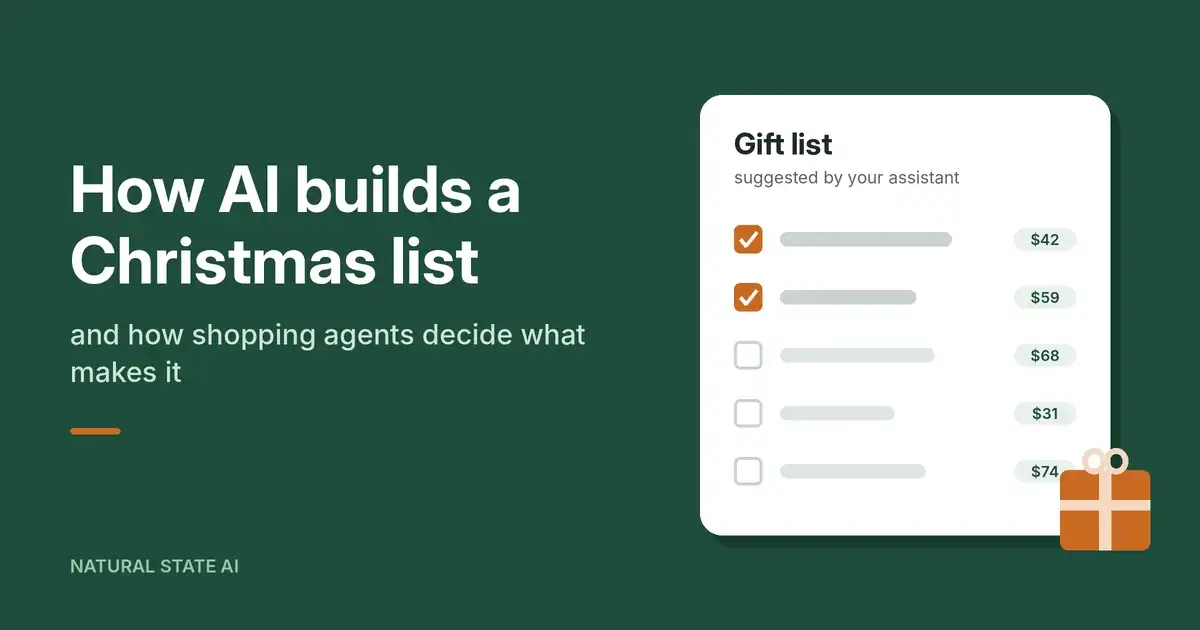
Last Christmas, asking ChatGPT for gift ideas still felt like a party trick. This year it’s just how a lot of people start their list. You type “my brother-in-law is turning 40, he’s into smoking meat and Razorback football, $75 budget” and you get five ideas back with prices and links.
That’s great if you’re the one shopping. If you’re the one selling, it raises a pretty blunt question: when somebody asks for gift ideas, how does the agent decide which five products to name? I’ve been digging into both sides of that this fall, so here’s what I’ve found.
It depends a lot on how you ask
Every big research shop put out a holiday AI number this fall, and they’re all over the place. I don’t think that means anybody’s wrong. They’re just asking different questions.
Here’s how I read it. Most people have used AI for something shopping-related, but almost nobody thinks of it as their main gift advisor. Friends and family still win that one easily (50% ranked them first in the Mall of America survey). AI isn’t replacing asking your sister what your nephew wants. It’s getting stacked on top of it.
Gartner had a stat I really like on this. People who use AI for holiday inspiration actually check more sources than people who don’t.
So if you’re thinking of AI as one more channel to check off, I’d push back on that a little. It’s more like a layer that sits on top of every other channel, which is a big part of why I keep saying tracking alone isn’t a strategy.
The traffic that does show up is really good
This is the part that should get retailers’ attention. Adobe has been tracking clicks from AI assistants to US retail sites since late 2024, and the conversion story has flipped fast. In September, AI referrals converted 90% better than everything else and brought in 83% more revenue per visit.
That makes sense to me. By the time someone clicks out of a chat, they’ve already narrowed things down. They’re not browsing anymore, they’re buying.
And Adobe expects a lot more of it this season, with the biggest jump on Thanksgiving:
What people are actually asking AI to do
Visa asked which shopping jobs people are comfortable handing off. Gift ideas made the list, but they’re not at the top. Comparing prices is.
When it comes to the list itself, the conversation usually goes something like this. (This is an illustration, not a real transcript.)
That third step matters more than people think. The first round is almost always safe stuff (a candle, a gift card, a nice mug). It’s the second and third rounds, after “he already has that” or “something more unusual,” where specific products and smaller brands start showing up. If you sell something niche, that’s usually where you’re competing.
One more fun one from Visa: 41% of people wouldn’t tell someone that AI helped pick their gift. So a lot of this is happening quietly, which also means you probably won’t hear about it from your customers. (Another reason I’d add an AI option to your “how did you hear about us?” field. I get into that in the attribution problem.)
How the agents decide what makes the list
Nobody publishes the full algorithm, so everything here is pieced together from what the platforms have said and some outside studies. But the general shape is pretty consistent across ChatGPT, Gemini, Google’s AI Mode, Perplexity and Amazon’s Rufus.
1. Your request turns into a bunch of searches
“Gift for my dad who likes fishing and coffee, under $60” isn’t one search. The agent quietly splits it into several narrower ones (query fan-out). And here’s the stat that I think a lot of people miss. A March 2026 analysis of over 43,000 ChatGPT shopping carousel products, reported by Search Engine Land, found most of them came straight out of regular Google Shopping results for those sub-queries.
Translation: if you’re invisible in regular Google Shopping, you’re probably invisible in the AI version too. The boring fundamentals still carry a lot of weight here.
2. Candidates come from product data
Agents pull from shopping indexes and merchant feeds (Google Merchant Center, feeds submitted to ChatGPT, Shopify’s catalog, which has been on by default in ChatGPT for eligible US merchants since March) and from crawling product pages. If the bot can’t crawl your site or your feed is thin, you’re not even in the pool.
3. Hard constraints knock products out
Price, age range, size, in stock, ships in time. This part is pretty mechanical, and it’s where a lot of products quietly lose. A stale price or a wrong “out of stock” flag gets you cut before ranking even starts. And in December, delivery dates matter a lot.
4. Ranking comes down to fit and proof
Of what’s left, the agent picks the products it can make the best case for. The signals that keep coming up:
- Fit to the exact ask. The product that answers the specific request beats the generically popular one.
- Specific reviews. “My dad uses it every morning at the lake” gives the agent something to work with. “Great product!” doesn’t.
- What other people say about you. Gift guides, editorial roundups, Reddit threads, YouTube reviews. Agents cross-check your claims against outside sources. (This is the whole idea behind being recommendable.)
- Complete structured data. One vendor study of 500 shopping queries found structured data completeness was the strongest predictor of which products got recommended. Source. It’s a vendor study, so take it with a grain of salt, but it lines up with what I see.
5. Ads are part of it now
This is the big change since last Christmas. OpenAI turned on ads in ChatGPT in February, labeled “Sponsored” and shown below the answer for Free and Go users, and since May retailers can plug in a product catalog and run shopping ads there. Google’s AI Mode has labeled sponsored shopping spots too. Source
The platforms say the organic picks and the paid slots are kept separate. So this season there are really two games: earning a spot in the answer, and buying one under it. I’d want to be doing the first one no matter what.
Gift searches are a different animal
Here’s what I think most product pages miss. Gift searches are about the person. Product pages are about the product.
Someone asks for a gift for a 12-year-old who’s into robotics but hates screens. Your page says “STEM kit, 140 pieces, ages 10+.” The agent has to connect those dots itself, and it’s going to lean on whoever already did, usually a gift guide or a review that says “my 12-year-old loved this and it got her off the iPad.”
So the businesses that get surfaced for gift queries tend to be the ones whose pages and outside coverage answer “who is this a good gift for?” in plain words.
If I were a retailer, here’s what I’d fix before Black Friday
Adobe expects AI traffic to spike hardest around Thanksgiving, so there’s about three weeks. This is the order I’d go in:
- Clean up your feed. Prices, stock, GTINs and shipping info all current in Google Merchant Center (and Shopify, if you’re on it). Wrong data gets you filtered out before ranking even happens.
- Add holiday shipping cutoffs. “Order by Dec. 18 for Christmas delivery” on product pages and in your shipping settings. Agents filter on arrival dates in December.
- Make sure the bots can get in. Check robots.txt for OAI-SearchBot, PerplexityBot and Googlebot. Blocking them is the easiest way to disappear.
- Write “who it’s for” copy. A couple of plain sentences per hero product. Great for the dad who fishes, the teen who’s hard to shop for, the coworker gift under $25.
- Spell out the gift-friendly stuff. Gift receipts, gift wrap, extended holiday returns. That comes up a lot in gift questions.
- Get into gift guides. Local publications, niche blogs, creators. Those roundups are exactly what agents lean on for gift queries. PR earns its keep here.
- Ask for specific reviews. Your post-purchase email can ask who they bought it for and how it went. That’s the language agents pull from.
- Test it yourself. Ask ChatGPT, Gemini and Perplexity for the gifts your product should win, the way a real shopper would, including the pushback round. See who shows up and what sources get cited.
None of this is exotic. It’s mostly good product data and good earned media, just with a holiday deadline attached.
Want to know whether AI is recommending your products this Christmas? See our services or get in touch and we’ll run the gift searches your customers are running.
Leave a Reply